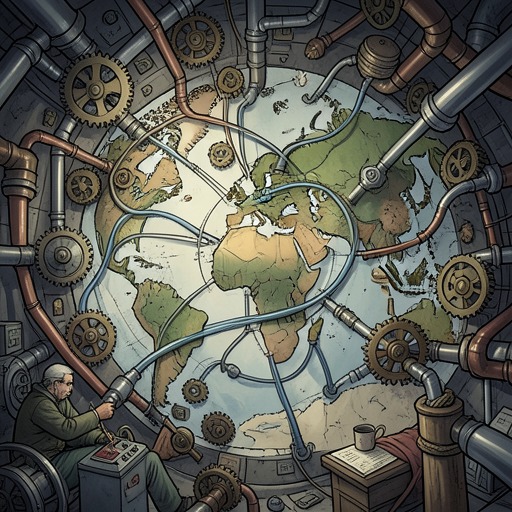
Worldlessness of capitalism
The Parallax ViewWorldlessness of capitalism describes a global order that reaches across cultural worlds yet does not constitute a coherent world in which most people can locate meaningful forms of collective life and action. Its defining paradox is that capitalism’s universal reach does not produce a universal civilization: it operates as a relatively neutral economic and symbolic machine, while dissolving stable representations and continually remaking its own limits. This condition unsettles the familiar model of emancipation, in which excluded people can challenge an established social order from the excess that order cannot accommodate.
A Global System Without a Shared Map
The argument distinguishes worldlessness from mere isolation or the absence of social connection. Capitalism encompasses different cultural settings, including societies organized around Asian values, without becoming the name of one specific cultural-symbolic world. Its universality is therefore not simply Europe’s cultural victory over the rest of the globe. Rather, the worldwide expansion of capitalism can mean the self-obliteration of Europe as a distinct center, as economic relations detach from any single inherited cultural frame. Critics who search only for capitalism’s hidden Eurocentric bias, the account argues, miss the more unsettling claim: the system’s universality lies in its capacity to function across cultural differences as a neutral matrix of social relations.
Worldlessness has a cognitive and political dimension. A meaningful world would allow people to map their situation, identify the stakes, and understand how they might act within it. The account contrasts capitalism with Nazi anti-Semitism, which, despite its murderous falsification of reality, disclosed a comprehensible ideological landscape to its adherents: it named an enemy, characterized a crisis, and supplied a goal and means. The contrast does not make that world meaningful in any ethical sense. It shows instead that capitalism can be more disorienting: it is global and all-encompassing, yet deprives the great majority of a meaningful cognitive map for engagement.
Capital, Form, and the Instability of Representation
The diagnosis is connected to an account of how capitalist value works. Drawing on Kojin Karatani’s reading of Karl Marx, the text rejects the idea that production alone reveals the truth of value while circulation is merely an illusion. Value has to be understood through the parallax between production and circulation: neither side can be reduced to the other. Capitalist production itself becomes a detour within the process of money generating more money, so speculative logic cannot simply be assigned to an unproductive financial sphere and opposed to a healthy, substantial economy. The drive to accumulate is also bound up with the continuing transformation and expansion of production.
This formal account makes the commodity a small-scale illustration of capitalism’s power to unsettle ordinary frames of meaning. A table remains wood as a useful object, but, once it enters the commodity form, it acquires a social standing that is not explained by its material properties alone. Its value depends on its place in a system of relations among commodities. In the book’s reading of Marx, the commodity’s apparent autonomy is not a superficial disguise that can be discarded to reveal a self-sufficient essence underneath. The form itself is essential: social relations operate through it. That insistence helps explain why capitalism can undermine stable representation without simply revealing a more secure social foundation behind appearances.
The same instability creates a problem for political action. In precapitalist formations, a state’s representation of society could leave a part of the system without a proper place. Emancipatory politics might then emerge from this excluded element, which belonged to the situation but could not be counted within its terms. Capitalism, by contrast, reproduces itself through repeatedly overcoming its own limits and turning what exceeds the system into a possible driver of its renewal. If the system continually produces and absorbs excess, the excluded position cannot automatically serve as a stable foothold from which to challenge it.
Social Excess and the New Proletarian Position
The text gives this structural problem a concrete social scale through the uneven distribution of work and connection. An extrapolation of the 80/20 rule suggests that a global economy may come to require only 20 percent of the workforce for the necessary work, leaving 80 percent potentially unemployed and treated as irrelevant. The argument does not treat those workers as the only possible universal political subject, but the figure dramatizes a system in which growing productivity can coexist with the exclusion of a vast population from secure social usefulness.
Scale-free networks provide a related model of concentrated power. A small number of nodes accumulate many connections while most have relatively few; competition may continue as leading nodes change, but at a threshold a network can become winner-take-all. Microsoft is given as an example of a privileged node: others must relate to it in order to communicate with still other entities. The example makes concentration more than a matter of a single firm’s size. It shows how control over a central position can reorganize the connections available to everyone else, even where a network initially appears competitive.
The inhabitants of slums in expanding megalopolises are proposed as a particularly important candidate for a new proletarian position. Lagos illustrates the scale and uncertainty involved: the text describes a shantytown corridor of 70 million people stretching from Abidjan to Ibadan, and reports that about two-thirds of Lagos State’s 3,577 square kilometers could be classified as shantytowns or slums. The city’s population is officially given as 6 million, while many experts estimate 10 million. Such discrepancies are part of the political picture: a large population lives beyond effective state control and partly outside the law, while needing minimal forms of self-organization.
These residents are not simply a surplus detached from the economy. They include marginalized laborers, redundant civil servants, and former peasants; many work informally for wages or as self-employed entrepreneurs, without adequate health or social security coverage. The account links the growth of this population to the incorporation of Third World countries into the global economy, including cheap food imports from First World countries that damage local agriculture. Slum life thus registers the effects of development, modernization, and the world market as products of capitalist logic, not as accidental failures at its margins.
The Political Task: Making a World
The predicament is sharpened through Alain Badiou’s account of the event. If emancipatory politics has traditionally intervened at the point where a state’s representation fails to include an excessive element, capitalism presents a different situation: it already unsettles representational frames and turns the overcoming of limits into a condition of its own reproduction. The question is no longer simply how an event can disrupt a bounded historical world. It is how emancipatory politics can intervene in a universe whose ordinary operation is already worldless.
That reversal leads to a distinctive political proposal. In this setting, the task may be to form a new world and to propose new master-signifiers capable of providing cognitive mapping, so that those who are excluded can invent names that sustain new truth procedures. The proposal sits uneasily beside a theory in which events disrupt worlds and their organizing regimes. Here, instead, political intervention takes on an ordering task: it must help construct a shared frame in which collective action becomes intelligible. The text notes the resonance between this position and the slogan that another world is possible, while leaving the tension in view. Worldlessness is therefore not simply a description of capitalism’s reach; it names the political difficulty of finding an emancipatory point of orientation inside a system that dissolves established worlds and continually incorporates the excess its own expansion generates.